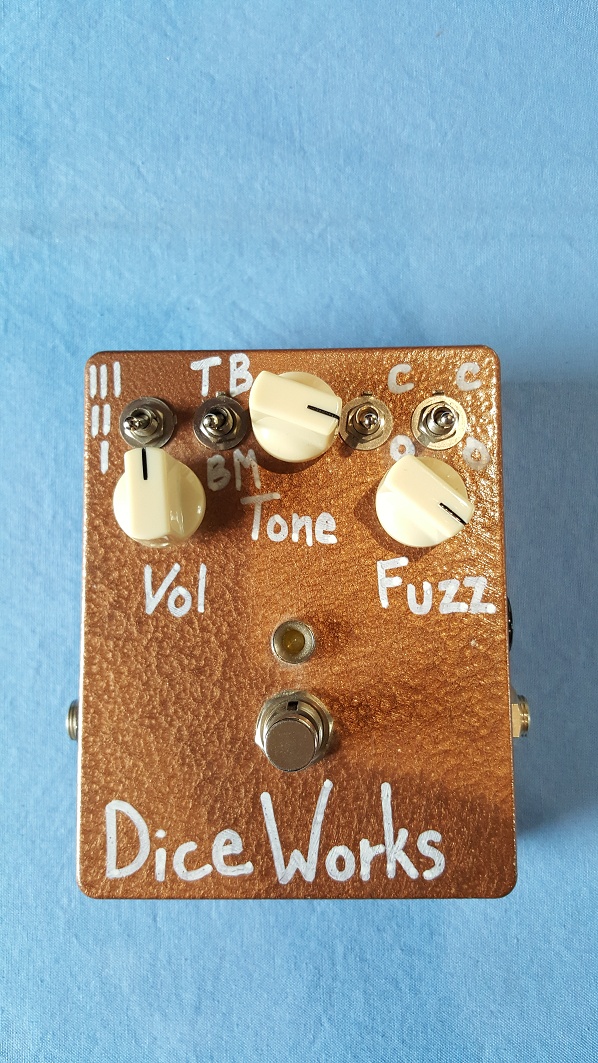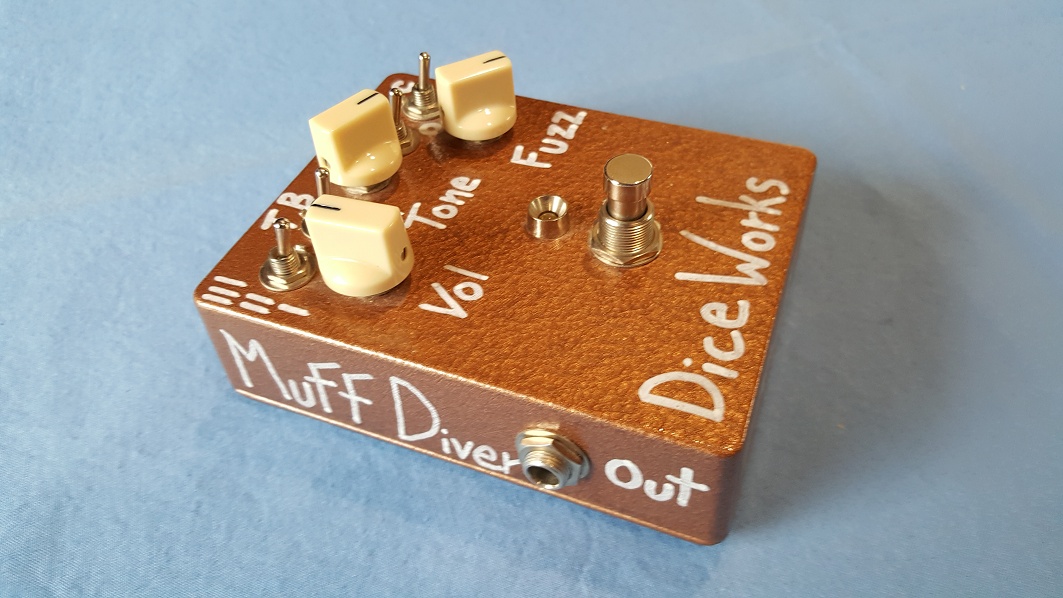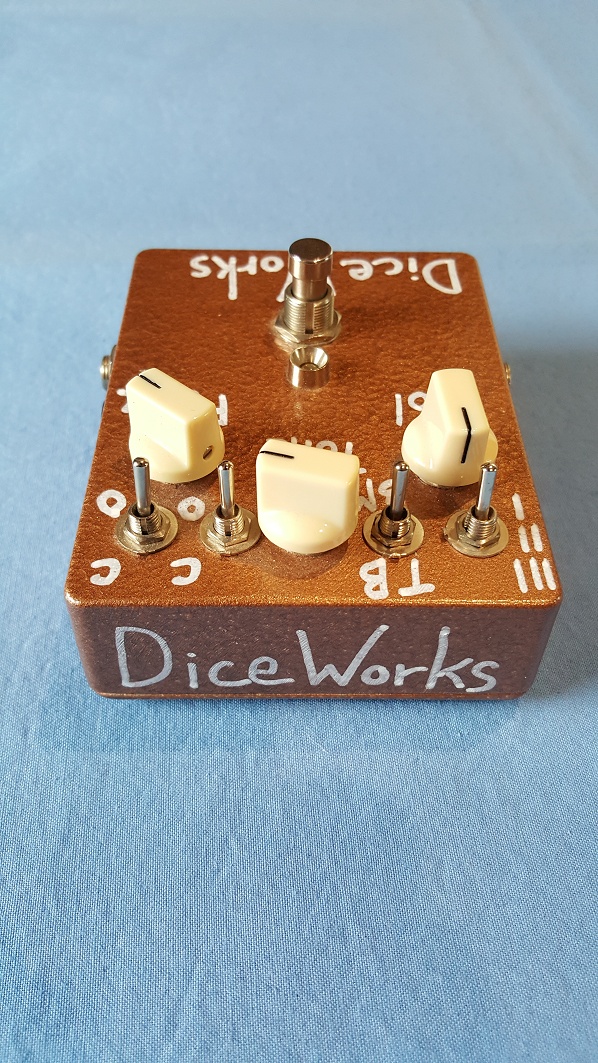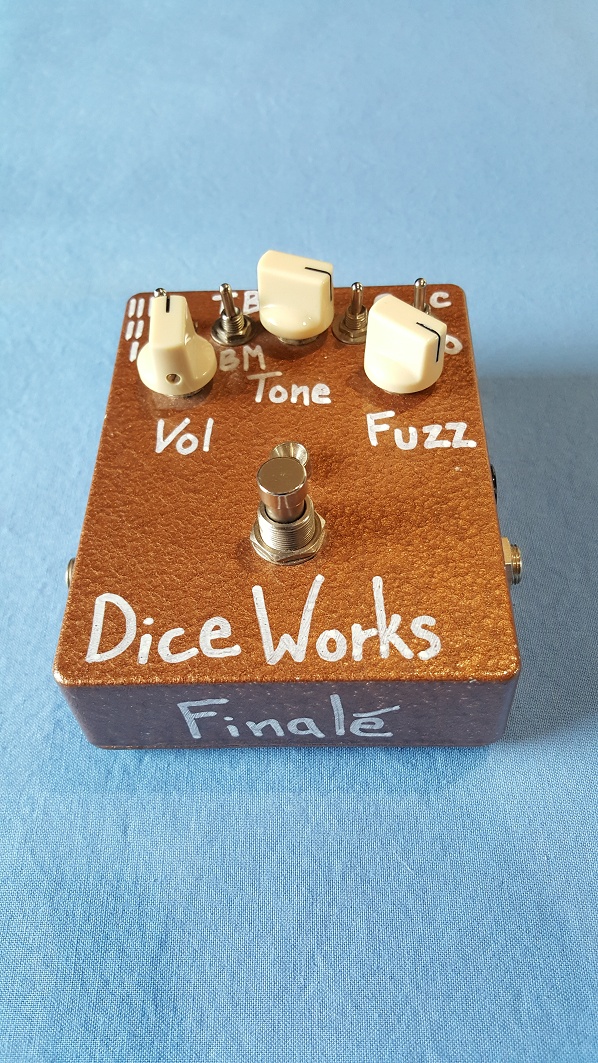





Dice Works Muff Diver Finale
ID: 727
Price: $450
Shipping: TBD
Dimensions: 8x6x6
Weight: 1 lb 6 oz
Mint, like new condition.
Well, well, well. Let's talk story. Some of this I know to be true, some I expect is true but do not know for sure. Some is speculation.
Sometime around 2006 a guy named Eric Holden was hand-building pedals under his company name of Dice Works. Among the few models he offered was a group of models named Muff Diver, Muff Diver Finale, and perhaps some others. These were among the first boutique builds available. They were cloned/modified copies of the EHX Big Muff Pi, with some Pete Cornish mods added on as switchable options to provide several different Big Muff tones from a single pedal. The base circuit was an original Triangle circuit, although he may have also built some Ram's Head or other versions later on. At any rate, he started with the Muff Diver and added options until he got to the Muff Diver Finale, like the one I'm offering here. It has a raft of switchable options (see below for some more detail), based on the Triangle circuit. It's sort of a Big Muff/Tonebender/Pete Cornish mash-up. The whole pedal is hand-built. Some think that the handwritten labels on the pedal suggest low quality. I can point out that after about 20 years (OK, much of it in storage) the finish and labeling are still in outstanding condition, unlike a number of commercial pedals I've owned for a similar number of years. Inside is a mix of perfboard and point-to-point wiring that is pretty clean, kinda like those hand-wired pedals from the 60's and early 70's that are still running today...
The transistors are BC327. I don't know of any Big Muff that used BC327 transistors, but certainly different models of transistors were used. Perhaps these were what Eric found available that sounded to him like the original Big Muff transistors that were already difficult to find by the time he started building. There is also some possibility that an early Big Muff Pi schematic that was posted and used as the basis for many clones in the early boutique days may have specified BC327. We'll probably never know why he picked them, but they sound fine.
Eric sold his pedals on eBay. I bought this pedal directly from him on eBay in 2008. The transaction went smoothly, and he followed up by emailing me some instructions for using the pedal. I also have a second document, which may have been the text from his eBay listing for the pedal. Both documents are copied below. (If you buy this pedal, feel free to copy the info in the documents below.) Anyway, all was well and I received exactly what I expected shortly after the sale ended, no problems at all. Sometime after that transaction, Eric sort of disappeared and other buyers apparently never received their pedals. There were rumors of "fishing trips", "pedal building burnout", and even his death. I don't know what became of him, but his reputation certainly took a big hit and people lost their money.
But that's only part of the story. I don't know what his background was, but Eric built some great pedals. He seems to generally have had a waiting list, although he seemed to sell primarily through eBay and most people just had to wait until he listed pedals for sale there. The Muff Diver and particularly the Muff Diver Finale became *THE* Triangle clone to get. It's difficult for a boutique builder to break through and get that popular that quickly. I'm not sure how he did it. The Muff Diver Finale became very popular and reviewers raved about it and the other Muff Diver pedals. I don't think he actually made that many of them. I've seen estimates of around 200. My guess is the number may be lower than that. Maybe he built and sold 200 or so pedals of all the different models he built. But I don't know that. I'm just guessing because for years I watched for them to go on sale and saw very, very few. That's the reason why you may not have heard of the Muff Diver Finale. By sometime around 2010, give or take a smidge, Eric had disappeared. While he was building, the Muff Diver Finale was so highly rated that he could charge a price which at the time was pretty high. Second-hand pedals were scarce, as they still are today, of course. Those old reviews of his pedals are still out there, so you can see some opinions about them. They used to sell for more than I'm asking, but after nearly 20 years, not many people know about them. If you are a Big Muff Pi expert, then you probably know.
So there you have it - a highly-rated pedal, a rare collectible, a story, and a mystery all mixed together.
Info possibly from the eBay listing when I bought the pedal (I think the review links at the end are now bad, but you can Google for reviews):
Technically, you are getting 24 different pedals in one- the original Triangle Big Muff, my Cornish mods Muff, the Colorsound (Sola Sound) Supa Tone Bender (used by Steve Hackett), the Guild Foxey Lady, and two switching toggles that change the output volume and saturation. 4 different EQ settings, times 6 different drive options adds up to 24 variations. From the thick congested tone of the modern Big Muffs, to the thinner trebly tones of a certain Pink guitarist, with a myriad of saturation options- fully saturated with a dynamic, richly harmonic edge, to a cleaner, loud boost like a Linear Power Booster with some grit and girth. Several options have never been heard before, as no one else has concieved them before.
The effect itself is PNP (so you need positive tip adapter power, single wall-wart, or VooDoo2 only), true-bypass and uses a rare NOS Phillips transistor that I am extremely happy with. GREAT numbers, low noise, and built better than most other TO-92 transistors. See for yourself. The transistor on the left (in both groups of three) is physically larger, more rugged. I've been through ALOT of transistors for this effect and these are without a doubt the best. It will even clean up with your guitar volume (not like a Fuzz Face, but still very usable).
Also consider that this effect eliminates approximately 6 feet of wiring and patch cables (assuming 3 six-inch cables, and the internal wiring of each effect), which creates less of a load on your tone, and frees up space for more effects.
Samples forthcoming, but the 24 different options, with different settings on the fuzz and tone knobs, would be over 70 samples to fully illustrate everything this pedal can do. I already have samples of the different EQ options (from my other Muff Diver), and I'll try to abbreviate the rest (I don't want to take 70 samples any more than you want to get 70 samples...).
Product comes with full, lifetime service warranty, plus 48-hour refund policy. If you don't like it, all it costs you is return shipping.
Couple of Harmony-Central reviews for you (it's all the same circuit, just different options);
http://reviews.harmony-central.com/reviews/Effects/product/Dice+Works/Muff+Diver/10/1
http://reviews.harmony-central.com/reviews/Effects/product/Dice+Works/Triangle+Big+Muff+Clone/10/1
Instructions that Eric emailed to me:
Hi Bill, here's the instructions for the Finale. I thought I sent them to you, sorry.
From right to left the toggles are;
O/C1- Original/Cornish Mods1
O/C2- Original/Cornish Mods2
TB/BM- Tone Bender/Big Muff switch for Colorsound Supa Tone Bender (TB) used by
Steve Hackett and the Big Muff (BM) for the Triangle Big Muff
I/II/III- This is for 3 different areas of drive/clipping. (I) is the Triangle
Big Muff (II) is a variation if the Supa Tone Bender, and (III) is the 80's
Soft Suatain.
Settings;
All four toggles in the down position is the original Triangle Big Muff
(O/O/BM/I).
For Gilmour's tone, leave the TB/BM and I/II/III toggles in the down position
and experiment with the O/C toggles. I like both toggles up on the "C" positions.
For the Steve Hackett/early Genesis tones, you have two options; leave all the toggles in the "down" position, except the for the TB/BM switch to "up" (TB). Or leave the TB/BM switch on BM, and set the 3-way toggle toggle to position II. One setting has more overall volume, but both have a bass spike.
The Foexy Lady is the same thing as the Triangle Muff. Long story short, there were two main versions of the Foxey Lady; the original two-knobbed, two-transistor version (which my pedal won't do), and the three-knobbed, 4-transistor version which is the same as the triangle muff. There were two-knobbed 4-transistor versions as well, but there was a fixed resistor instead of a pot for tone. Turn the tone knob on my pedal to about 12 O'clock in Triangle mode, and it's the same thing.
Overall, there are 24 different toggle combinations, experiment.
- t-booster