





Custom Muff Tone Device
ID: 790
Price: $180
Shipping: TBD
Dimensions: 8x6x6
Weight:
OK, options means details, sorta. But this can be either simple or easy - nothing complicated here. Here are the choices you make, with some detail about those choices below.
1. Choose your circuit
2. Choose component types if you want something other than the default for your circuit
3. Choose enclosure color
That's it.
1. Choose Your Circuit
You can choose one of several default circuits. These are a mix of EHX and third-party versions of the Big Muff Pi that are among the best in my opinion. This is your most important choice and will have the biggest impact on how the custom pedal will sound. At the end of this page is a generic circuit diagram for the BMP. Use that diagram to communicate any components you want to change or if you want to provide a different BMP circuit to be built. I highly encourage BMP fans to visit Kit Rae's Big Muff Pi Page, which contains mountains of information about the Big Muff Pi.
MTD Triangle 1
The first version of the BMP was called the "Triangle" version because the 3 knobs were in a triangle arrangement. But the Triangle version, just like most of the later versions, was not a single circuit. There were many different circuits, so many that it is difficult to say that there is a common sound among them. All those circuits sounded slightly different, especially due to parts substitutions during manufacturing. This particular circuit was probably manufactured more than all the others, perhaps accounting for around half the Triangle pedals built. This is our build of Kit Rae's 67#1 schematic. In addition to being the most-used Triangle circuit, it was also one of the first to be cloned, resulting in the Foxey Lady pedal.
MTD Triangle 2
This is obviously another Triangle circuit. Many years ago boutique pedal builders, as well as larger commercial builders, began reverse-engineering and copying popular pedal circuits. Some are just outright copies, others are slightly tweaked or have additional features or modifications. This is all perfectly legal, since pedal circuits are in the public domain. But it gave rise to a bit of seediness in the pedal industry that thrives on to this day. Anyway, people didn't realize that there were dozens of BMP circuits back then. As inevitably happens when there is a new pedal on the market, someone quickly reverse-engineers it and publishes the schematic (either with or without mistakes...). That happened to the BMP. The actual version of the circuit that was sort of randomly chosen turned out to be a fairly uncommon version, so it cannot be said to have much of a claim on being "the sound" of the BMP, even if there was "a" BMP sound among all those circuits. Luckily, that circuit happened to be one of the better-sounding ones. For years, that circuit was used as the basis for many very popular clones and derivative BMP pedals. Many adopted this as the standard for the Triangle BMP sound, whether it actually was or not.
While there are dozens and dozens of Triangle circuits, the Triangle 1 above accounted for half or more of the actual Triangle pedals people might have heard. The popularity of the cloned Triangle 2 circuit accounted for another big chunk of the popular Triangle clone pedals. Between these two, there's a reasonable chance that you might get "the Triangle sound" that you may be looking for. But there are so many other circuits, along with the pesky component differences and component aging that make it virtually impossible to match any particular tone you may have heard from a Triangle circuit
MTD Ram's Head
Just like with the Triangle, there were many circuits in the second version of the BMP, known as the Ram's Head due to the new graphic of a ram's head that appeared on the pedal, along with a rearrangement of the knobs into a line instead of a triangle. Of course those are just appearance differences. The Triangle and Ram's Head pedals are just a huge collection of many different versions of the same base circuit, built from whatever components were available as the component values were tweaked over time. There were/are many great guitarists that have used the BMP to achieve signature tones. One of the most popular is David Gilmour of Pink Floyd. He used multiple different BMP versions to get his iconic fuzz tone and the variations of it that he has created throughout his career. Without getting side-tracked into a complex and interesting discussion about all that, let's just cut to the chase and note that he used a Ram's Head circuit, probably one in the sub-group of "Violet" Ram's Head. But the component values were all over the place, many well out of their spec ranges, and his pedal(s) were modified. All that makes it virtually impossible to get a BMP that sounds just like his, but the Violet Ram's Head circuits sound close, particularly the first version of the Violet Ram's Head circuit, which is what we build for this choice.
MTD Red Army Overdrive
EHX had financial troubles at one point, yet another interesting story of its own. The result was that for several years BMP pedals were built in Russia. While there are multiple versions of these Russian pedals, for several years the circuits remained almost identical, a big break from the past, until the variations started again with the "Black Russians" just before production moved back to the USA. The first version of these nearly identical circuits was used in the Red Army Overdrive and the early "Civil War" BMP pedals. This is our implementation of that first Russian BMP circuit.
MTD Tall Font
Small tweaks to some components were used in the later versions of the Civil War BMPs and the Tall Font BMPs that came immediately afterwards. This is our implementation of that tweaked second Russian BMP circuit.
MTD Bubble Font
More small component tweaks led to the third Russian circuit which was used in the Bubble Font BMPs and maybe into the jumble of Black Russians that followed. This is our implementation of the that third tweaked Russian BMP circuit.
Of course, you may know that David Gilmour also used some of these Russian BMPs. Again, you can check it out at Kit Rae's site or one of the sites devoted to David Gilmour's gear and tone. But here's the skinny on these three Russian circuits. They are almost identical. It seems that the only intentional difference was the value of the clipping caps. The values used were 430, 470, and 500pF. But with a typical spec range of +/- 10% or even 20%, a 430 could actually be a 470 and a 470 could actually be a 430 or 500. Or a 430 might be closer to a 390 and a 500 closer to a 550. Since that was the only intended difference, there's really no way to know what you've got until you play it. The difference can be heard. Complicating the "identical circuits" a little more are the clipping diodes. There were several different Russian silicon clipping diodes used. They should all sound pretty similar, but there are slight differences. Again, it is a matter of what parts were actually used, and those different diodes were used in all three circuit versions. Even with "identical" BMP circuits, your results are going to vary.
I found this out very early on when I started building Russian BMP pedals. Since I'm such a clever guy, I realized it was pretty easy to put two sets of clipping capacitors in a single pedal, with the ability to select which set of caps you wanted with a single switch. Very cool - a 2-for-1 pedal. Want the Red Army Overdrive sound and the Bubble Font in the same pedal on a switch - done! But to my horror, after building those pedals (which while simple in concept is quite a chore in reality), I could flip that switch and the sound was identical! Or it would seem I had wired my switch backwards and had the Bubble Font wiring on the Red Army Overdrive setting! That's when I really learned about parts tolerances and what a difference they make. You could easily select 430pF caps and have actual cap values over 500pF, a completely different sound.
To prevent that happening in the MTD, I carefully measure and select those capacitors to be close to the values wanted for the circuit, not just the values printed on the capacitors. If you look inside and expect to see capacitors of a particular value and see the "wrong" ones, never fear. Their actual, not printed values, are being used to get the correct intended sound. I also have a good number of all those Russian diodes. There is no standard for which diode was used in which circuit version. But mine are consistent among the combinations used. All three circuit versions get their own diode version to prevent "overlaps" in the resulting sound, at least to the extent that can be done through selection of the diode models. Anyway, interesting stuff, lessons learned, options hinted at, steps taken, stuff to think about...
MTD Creator
The Jordan Creator was one of the earlist BMP Triangle clones. It is an oddity. A BMP has three knobs - Sustain, Tone, and Volume. The Jordan Creator is a rocker pedal, which looks like a wah or volume pedal. It has the Sustain and Tone control knobs, but the Volume is controlled by the rocker. And if you switch off the BMP, you are left with a Volume control pedal. Check it out at Jordan Creator The BMP circuit that was selected is a Triangle-era circuit, perhaps tweaked a bit. With all those Triangle circuits, it is difficult to say. What is definitely true is that tweaked or not, it is a very good Triangle circuit, among the best of all the clones and even many of the originals. This is our implementation of that circuit.
MTD Supa
The BMP sound was so popular that it was used "secretly" in some pedal copies. There are some Ibanez/Maxon distortion pedals that are actually BMP fuzz circuits inside. The same is true for some Tonebenders. This circuit is the one Colorsound used to make their Supa Tonebender. It is a BMP Ram's Head with some significant mods to get it to sort of fit somewhere between a BMP and Tonebender sound.
MTD Circuit Components
The following chart shows the component values and types that will be used by default in the MTD builds. One column of part numbers lets you match parts to the Standard BMP Circuit diagram below. The others are the part numbers on the MTD board. In retrospect it would have been a pretty good idea for me to use the same part numbers in the MTD as in the Standard diagram. Or maybe I could have settled on Kit Rae's part numbers, which are becoming pretty well known. But I didn't do either of those things, so there are some mappings required from one to another.
A couple of abbreviations: CC is carbon comp for resistors, MF is metal film. Film capacitors are "greenie" style polys. Electro is electrolytic capacitors.
| 67#1 | 72#2 | Violet v1 | 7a | 7b | 7c | Jordon Creator | Supa Tonebender | ||
| Std Schematic | MTD | Triangle #1 | Triangle #2 | Ram's Head | Red Army OD | Tall Font | Bubble Font | Creator | Supa |
| R1 | open | open | open | open | open | open | open | open | |
| C1 | open | open | open | open | open | open | open | open | |
| R1 | R2 | 33K CC | 33K CC | 33K CC | 39K MF | 39K MF | 39K MF | 47K CC | 33K MF |
| C1 | C2 | 100n ceramic | 100n ceramic | 100n film | 100n film | 100n film | 100n film | 100n film | 100n film |
| R3 | R3 | 100K CC | 82K CC | 100K CC | 100K MF | 100K MF | 100K MF | 68K CC | 100K MF |
| R2 | R4 | 470K CC | 390K CC | 470K CC | 470K MF | 470K MF | 470K MF | 270K CC | 470K MF |
| R4 | R5 | 10K CC | 22K CC | 12K CC | 12K MF | 12K MF | 12K MF | 33K CC | 15K MF |
| R5 | R6 | 100R CC | 82R CC | 100R CC | 390R MF | 390R MF | 390R MF | 150R CC | 100R MF |
| Q1 | Q1 | 2N5089 | 2N5089 | BC239 | KT3102E | KT3102EM | KT3102EM | 2N5089 | BC184 |
| C2 | C3 | 500pF ceramic | 560pF ceramic | 470pF ceramic | 430pF SM USSR | 500pF ceramic | 470pF ceramic | open | 470pF ceramic |
| C3 | C4 | 100n ceramic | 100n ceramic | 100n film | 100n film | 100n film | 100n film | 100n film | 100n film |
| SUS | SUS | B100K | B100K | B100K | B100K | B100K | B100K | A100K | A100K |
| R6 | R7 | 820R CC | 820R CC | 560R CC | 1K MF | 1K MF | 1K MF | 1.5K CC | 820R MF |
| C4 | C5 | 100n ceramic | 100n ceramic | 100n film | 100n film | 100n film | 100n film | 100n film | 100n film |
| R7 | R8 | 8.2K CC | 8.2K CC | 8.2K CC | 10K MF | 10K MF | 10K MF | 10K CC | 8.2K MF |
| R9 | R9 | 100K CC | 82K CC | 100K CC | 100K MF | 100K MF | 100K MF | 68K CC | 100K MF |
| R8 | R10 | 470K CC | 390K CC | 470K CC | 470K MF | 470K MF | 470K MF | 220K CC | 470K MF |
| R10 | R11 | 10K CC | 12K CC | 12K CC | 12K MF | 12K MF | 12K MF | 10K CC | 10K MF |
| R11 | R12 | 100R CC | 150R CC | 100R CC | 390R MF | 390R MF | 390R MF | 150R CC | 100R MF |
| Q2 | Q2 | 2N5089 | 2N5089 | BC239 | KT3102E | KT3102EM | KT3102EM | 2N5089 | BC184 |
| C5 | C7 | 100n ceramic | 50n ceramic | 100n film | 47n film | 47n film | 47n film | 100n film | open |
| D1 | D1 | 1N914 | 1N914 | 1N914 | KD521A | KD510A | KD522B | 1N4001 | open |
| D2 | D2 | 1N914 | 1N914 | 1N914 | KD521A | KD510A | KD522B | 1N4001 | open |
| C6 | C6 | 500pF ceramic | 560pF ceramic | 470pF ceramic | 430pF SM USSR | 500pF | 470pF ceramic | 560pF ceramic | 470pF ceramic |
| C7 | C8 | 100n ceramic | 100n ceramic | 100n film | 100n film | 100n film | 100n film | 100n film | 100n film |
| R12 | R13 | 8.2K CC | 8.2K CC | 8.2K CC | 10K MF | 10K MF | 10K MF | 10K CC | 8.2K MF |
| R14 | R14 | 100K CC | 82K CC | 100K CC | 100K MF | 100K MF | 100K MF | 68K CC | 100K MF |
| R13 | R15 | 470K CC | 390K CC | 470K CC | 470K MF | 470K MF | 470K MF | 270K CC | 470K MF |
| R15 | R16 | 15K CC | 22k CC | 12K CC | 12K MF | 12K MF | 12K MF | 33K CC | 15K MF |
| R16 | R17 | 100R CC | 82R CC | 100R CC | 390R MF | 390R MF | 390R MF | 150R CC | 100R MF |
| Q3 | Q3 | 2N5089 | 2N5089 | BC239 | KT3102E | KT3102EM | KT3102EM | 2N5089 | BC184 |
| C8 | C10 | 100n ceramic | 50n ceramic | 100n film | 47n film | 47n film | 47n film | 100n film | 100n film |
| D3 | D3 | 1N914 | 1N914 | 1N914 | KD521A | KD510A | KD522B | 1N4001 | 1N4148 |
| D4 | D4 | 1N914 | 1N914 | 1N914 | KD521A | KD510A | KD522B | 1N4001 | 1N4148 |
| C9 | C9 | 500pF ceramic | 560pF ceramic | 470pF ceramic | 430pF SM USSR | 500pF | 470pF ceramic | 560pF ceramic | 470pF ceramic |
| MIDS | SPDT on/on toggle | SPDT on/on toggle | SPDT on/on toggle | SPDT on/on toggle | SPDT on/on toggle | SPDT on/on toggle | SPDT on/on toggle | SPDT on/on toggle | |
| C12 | 5.6n ceramic | 5.6n ceramic | 5.6n ceramic | 5.6n film | 5.6n film | 5.6n film | 6.8n ceramic | 4.7n film | |
| R18 | R19 | 33K CC | 39K CC | 33K CC | 22K MF | 22K MF | 22K MF | 22K CC | 33K MF |
| C10 | C11 | 4n ceramic | 4n ceramic | 4n ceramic | 3.9n film | 3.9n film | 3.9n film | 2.7n ceramic | 4.7n film |
| R17 | R18 | 33K CC | 39K CC | 33K CC | 20K MF | 20K MF | 20K MF | 22K CC | 33K MF |
| C11 | C13 | 10n ceramic | 10n ceramic | 10n ceramic | 10n film | 10n film | 10n film | 10n film | 10n film |
| TONE | TONE | B100K | B100K | B100K | B100K | B100K | B100K | A100K | A100K |
| C12 | C14 | 100n ceramic | 100n ceramic | 100n film | 100n film | 100n film | 100n film | 100n film | 100n film |
| R19 | R20 | 390K CC | 390K CC | 470K CC | 470K MF | 470K MF | 470K MF | 270K CC | 390K MF |
| R20 | R21 | 100K CC | 100K CC | 100K CC | 100K MF | 100K MF | 100K MF | 68K CC | 100K MF |
| Q4 | Q4 | 2N5089 | 2N5089 | BC239 | KT3102E | KT3102EM | KT3102EM | 2N5089 | BC184 |
| R21 | R22 | 12K CC | 12K CC | 12K CC | 10K MF | 10K MF | 10K MF | 10K CC | 10K MF |
| R22 | R23 | 2.7K CC | 2.7K CC | 2.7K CC | 2.7K MF | 2.7K MF | 2.7K MF | 2.7K CC | 2.7K MF |
| C13 | C15 | 100n ceramic | 100n ceramic | 100n film | 100n film | 100n film | 100n film | 100n film | 100n film |
| VOLUME | VOL | B100K | B100K | B100K | B100K | B100K | B100K | A100K | A100K |
| components below here are for power and LED, not audio | |||||||||
| D5 | BAT41 | BAT41 | BAT41 | BAT41 | BAT41 | BAT41 | BAT41 | BAT41 | |
| C16 | 100u electro | 100u electro | 100u electro | 100u electro | 20u electro | 22u electro | 100u electro | 33u electro | |
| C17 | 100n film | 100n film | 100n film | 100n film | 100n film | 100n film | 100n film | 100n film | |
| R24 | 4.7K MF | 4.7K MF | 4.7K MF | 4.7K MF | 4.7K MF | 4.7K MF | 4.7K MF | 4.7K MF | |
| LED | red 5mm LED | red 5mm LED | purple 5mm LED | red 5mm LED | red 5mm LED | red 5mm LED | red 5mm LED | purple 5mm LED | |
If you have another version you prefer, no problem. I have the components to build most, but not all, of the EHX versions at Kit Rae's site, as long as they follow the general BMP schematic/component layout. Or maybe you have some other schematic. Just send me a copy and I'll let you know if it works on my MTD board and I have the specific components it requires. The board used for the MTD builds is simple and it doesn't support optional features, so don't pick circuits with optional features that require additional components. Many of the clones have extra parts added that won't fit on the MTD board.
By now, you must realize that it is virtually impossible, and technically and financially infeasible to try to guarantee that any build of any particular BMP circuit is going to sound the way someone might expect it to sound. With many dozens of actual component values used, component values straying far from printed/spec values, aging components, some unknown components, some parts such as diodes with unknown audio specs, differences in rigs and playing, etc, etc, etc there essentially are no standards to be found. If you want to duplicate the sound of your $2000 Ram's Head, you'll need to find someone that can destroy it very carefully, piece by piece without overheating the parts and changing their performance, measure each component's key values, figure out exactly the brand and production run in which each component was made, finding exact duplicates of all those, and reassemble a new circuit, hopefully not overheating any component enough to change its spec, and then with fingers crossed *hope* that it sounds similar. Good luck with all that! Most of us just keep buying BMPs hoping to stumble across "that one". The other option is to listen to loud rock and roll for many years, dulling your sense of hearing to the point that they all begin to sound about the same... So enjoy the hunt and don't be surprised where it leads you. With so many possibilities, it may be that you'll get surprised and find a "better" BMP that what you were looking for.
2. Choose Component Types
Each of the MTD default circuits above specify the types of components that are included by default. I know this sounds like heresy, but the particular component type doesn't make much difference. It is the values of the components that matter more. And the range of their values is what causes two "identical" Big Muffs to sound slightly different. Big Muffs were made with a wide variety of component types and values that were available during manufacturing runs, regardless of what might have been in the design. As a result it is difficult to have a definitive sound for any of the specific designs. Unless you have some pretty clear ideas of what you're looking for, we recommend sticking with the default choices for each version.
Regardless, it is still fair game to pick among the options that were used, or options that weren't used that could very well be better, or at least different. Let's go through the main options.
Transistors
Transistors are probably the most hyped component choices. But I'll tell you a secret that I've learned after building lots of BMPs of lots of different types/versions. They all sound great with the 2N5089 transistors. In fact, many sound better with 2N5089 transistors than the original transistors. The main value of a transistor (for these purposes) is called its "HFE", which is a measurement of how much gain it can produce. As long as you have reasonable transistors of the right HFE values, you're pretty much good to go. The range of HFE is very wide. EHX never tested and selected transistors for a specific HFE, much less a specific HFE for a specific position in the circuit. They just went by datasheet value ranges. A secondary characteristic of the transistor that can often easily be heard is how noisy it is. The 2N5089 is a low-noise version of the 2N5088. Both are excellent BMP transistors for pretty much any BMP versions, but the 2N5089 will give a cleaner sound. So that is a great all-around transistor for BMP clones.
There are others, though. In particular, the Russian BMP circuits from the Red Army Overdrive through the Civil War, Tall Font, and Bubble Font versions used a Russian KT3102E or KT3102EM transistor. These are the same transistor, with the KT3102E being packaged in a metal can and the KT3102EM packaged in plastic. Early pedals often used the KT3102E, while later ones used the KT3102EM. However, they seemed to use whatever was available at the time for those Russian BMPs. Later Russian BMPs (Black Russians) used a mix of several other types of transistors. There is a theory that the E transistors may be a little quieter than the EM versions, but I'm pretty sure I wouldn't be able to tell them apart in an A/B test.
We have many dozens of transistors in stock so if you have some specific one you'd like us to use, let us know and we'll see if we have it in stock. In addition to 2N5088, 2N5089, KT3102E, and KT3102EM, other good choices we have include BC239 (used in some Ram's Head and other versions), MPSA18, BC549C, 2SC828, 2SC1815BL, BC184, BC550C, BC546C, BC108C, BC109C, and others.
Note that these are all silicon transistors, as that is what works in BMP circuits. A few versions were PNP, but we stick to NPN models with the MTD board. We can talk germanium, but that's not what's intended in most BMP circuits and can easily get you outside even the wide range of HFE that was used. Which, of course, may be why you want to try it ...
Capacitors
Capacitors make a lot of difference in the BMP circuit. But most of that difference is based on their value, not their technology. For small values, the usual choice is ceramic, as was often used in the original BMPs. In a few cases, silver-mica was used. Ceramic is often a little warmer, with a little noise. Silver-mica is quieter, brighter, sometimes a bit sterile-sounding in some cases. These are the usual choices for caps in the 1n and smaller range, sometimes a bit larger to maybe 10n. Most of the time you'll want ceramic for less than 1n. Note that ceramic caps have values that are often +/- 20%. In practice, the values can easily vary by 50% or even more. EHX never tested individual caps for their values. I suspect this is the biggest reasons BMP pedals all sound different, especially those that used lots of ceramic caps, which were particularly popular/available during the early production of BMP pedals.
For larger values of 1u and up, electrolytic capacitors are often used since other technologies don't go up much higher than that. But electrolytic caps can be noisy. Film caps can now be found at 1u, and are often a better choice. Tantalum caps are available above 1u and are quieter, better caps than electrolytics. But here's the deal. Some of those electrolytic caps are not in the audio path, so it doesn't matter. But if you are going for a BMP tone with minimal noise, check with us about using tantalum in place of electrolytics.
That leave the mid-range cap values from about 1n up to about 1u. There's a fair amount of opinion about the types of caps available in that range. Personally I like the poly "greenie" style caps in this range. Box film caps are also OK. I don't stock tropical fish or other old/exotic caps. They may already be past their prime. But mostly, I'm not convinced there's an audible difference between the different technologies in this range, as long as it has the right value.
This is an area where I don't think part swaps will make much difference. Partially that is because certain value ranges are likely to be certain types of caps. But mostly it is because I do measure each individual ceramic cap to get a correct/close actual value instead of relying on spec values. It is common to test 50 caps to find one with a value close to the spec value, so that takes a lot of time (and a lot of caps). Film caps are generally much closer to spec values and only need to be tested for specific critical caps in a circuit. Electrolytic caps vary by at least +/- 20%, often +/- 50-100% or more. However electrolytic caps are rarely in the audio path and their values are less important.
Note that the Mids Scoop/Flat switch is standard. That's not a standard part of the BMP design. The Scoop position will give you a capacitor value intended for that BMP circuit version with its distinctive mid scoop tone. The Flat adds in a second capacitor that levels out the tone, removing the mids scoop.
Resistors
There are 3 main types of resistors for these circuits. In the "old days", there was carbon comp. These are kinda noisy, imprecise resistors. But their noise is rather pleasing noise that is just audible enough to give a pedal a bit of old school sound. The other two types, carbon film and metal film, are very similar. The main difference is that metal film usually comes with lower noise and more precise values. The low noise is generally good in high gain pedals where every bit of noise gets multiplied with all that gain. Metal film is the clear choice these days in most pedal circuits. However, if you dig that older sound, carbon comp can be very pleasant. It is noticeable enough that the older BMP versions might not sound quite right to you with the better metal film resistors. I personally like carbon comp in most of the BMP circuits, especially the ones in the Triangle and Ram's Head versions where carbon comp resistors were often used. However, the carbon comp resistor values can easily vary by 10% or more. Metal film is usually very close, within about 1% of their spec values. That's yet another reason the older BMPs sound different - they used carbon comp resistors of varying values.
Diodes
In the BMP circuits, diodes are used for clipping. Germanium diodes were rarely used in BMP circuits. Almost all of them are silicon. And virtually all the silicon diodes clip at the same narrow range of voltages. For that reason, the type of silicon diode used isn't that important. But some people claim they can tell one silicon clipping diode from another. I'm not sure I can. Maybe in a test just involving a stripped-down diode clipper, but in a circuit with a number of capacitors, transistors, and resistors, I would expect little of the sound difference would be attributed to the diode model instead of their clipping voltage. Nonetheless, diode type probably does have some audible impact. 1N914 and 1N4148 diodes are so commonly used as clippers these days that I almost consider them as standard. They are sort of the universal substitutes for silicon clipping diodes. But there are numerous others. We default to using what was used in the original circuits. We have dozens and dozens of silicon diodes in stock, so if you prefer something other than our recommendations, let us know and we probably have it. We also have a big variety of germanium diodes if you want to go that way. Germanium sounds noticeably different from silicon. The Germanium diodes clip at a variety of voltages and sound different from one to another. For a BMP circuit, I'd recommend sticking with silicon unless you have some specific knowledge about a potential germanium candidate. Germaniun clips at a lower voltage, so you tend to get heavier, darker fuzz.
Battery Box
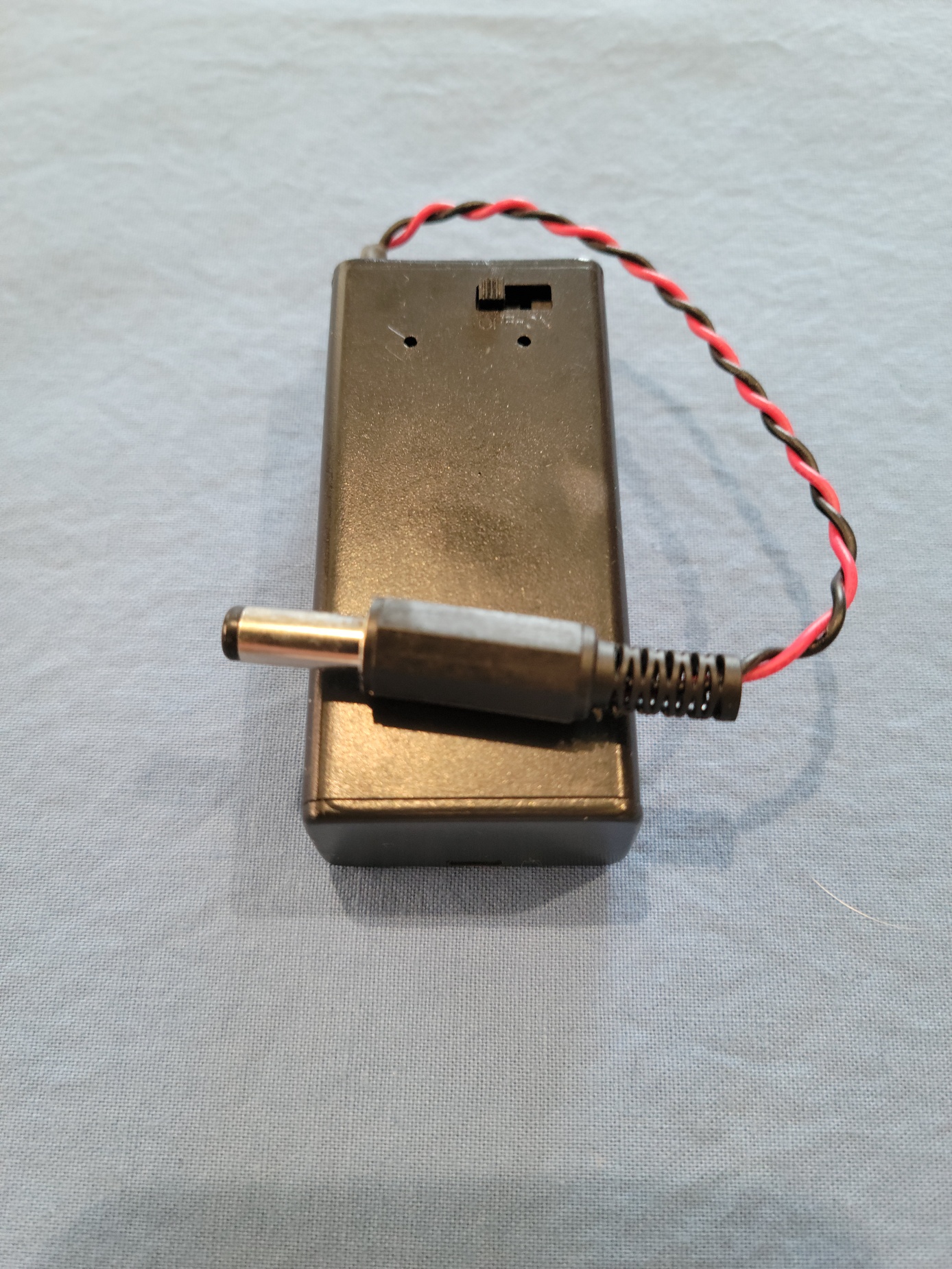
There is no support for internal batteries on these pedals. There is a standard 9VDC power jack instead. But if you prefer battery, let me know. I have several small plastic battery boxes that hold a 9V battery. There is an on-off switch and a standard power connector on a short cable. I only have a few available until I run out. No charge, first come, first served.
Mids Switch
The well-known BMP tone includes a mids scoop of varying degrees among the different models. One of the most popular BMP mods is a switch to get rid of that scoop and provide a flatter tone response. Although not shown in the Standard BMP Circuit Diagram below, this is included with the MTD. The switch adds another capacitor in parallel with C10, which adds its value to the value of C10 for an effective new value of C10. When the switch is Off and the Tone control is centered, you get the standard mid scoop of the particular BMP circuit version you've chosen. When the switch is On and the Tone control is centered, you get a flat frequency response. Of course, whether On or Off, the Tone control still cuts the low or high end as you expect, with or without the mids scoop.
Misc
Pots are 24mm.
Wire is stranded, of proper gauge.
Standard open frame mono audio jacks.
Standard black plastic DC jack with nut inside the enclosure.
Normal 3PDT footswitch wired for true bypass switching.
Standard 2-position toggle switch for mids.
3. Choose Enclosure Color
Color
White or "army green" are the two choices. I have a fixed number of each color. When they're gone, they're gone.
The enclosures are approximately 3.5" wide x 4.5" tall x 2" deep, not including feet, pots, knobs, jacks, etc.
Graphics
The Muff Tone Device was originally going to be only the Russian versions of the BMP, with their quasi-military look and build. Thus the green enclosure gets the "military" graphics while the white one gets something vaguely reminiscent of the old BMP pedals. Graphics/LED are black and red for Triangle and Creator circuits (all are Triangle circuits), black and violet for Ram's Head and Supa (both Ram's Head circuits), and black, yellow, and red for the Russian circuits.
Knobs
These are very nice, black machined aluminum knobs with set screws and white indicators.
Toggle Switches
Black switches on the green enclosures and chrome switches on the white enclosures.
Bezels
I use metal bezels for 5mm LEDs. Chrome finish on the white enclosures and black finish on the green enclosures
LED
If you don't like the default color, you can select any of clear/white, green, red, yellow, orange, blue, violet, and pink.
Adhesive Feet
I only have the black ones pictured. They will not be stuck on, just loose in the box. It's easy to find others at your local crafts and hardware stores.
Standard BMP Circuit Diagram
Use this diagram and component names if you need to specify a specific circuit outside our default circuits.
